
Complete Guides
Kitchen Remodel Long Island: Complete 2026 Guide
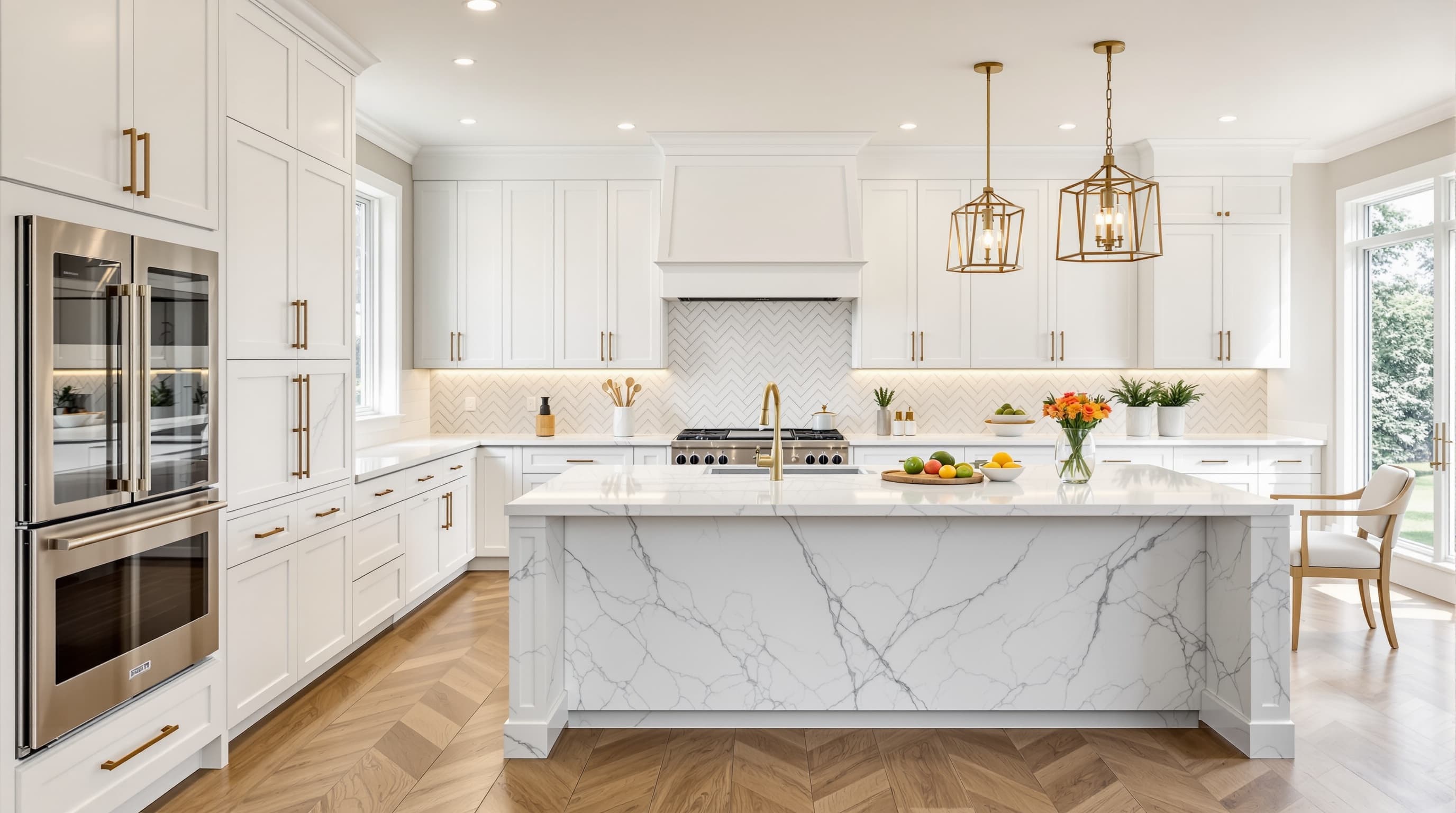
A kitchen remodel on Long Island is one of the biggest investments most homeowners make — and one of the most location-specific. Nassau and Suffolk counties have their own permit offices, their own contractor licensing requirements, their own housing stock characteristics, and their own cost drivers that make a kitchen remodel here different from a remodel in Connecticut, New Jersey, or anywhere else. This guide covers everything you need to know before signing a contract.
The first question most Long Island homeowners ask is: how much does a kitchen remodel cost here? The honest range is $15,000 to $175,000+, with the most popular full renovation — new semi-custom cabinets, quartz countertops, new flooring, updated lighting, and a backsplash in an existing footprint — running $30,000 to $55,000 for a typical 150-180 square foot kitchen. Long Island costs run 30-50% above national averages due to higher labor rates, permit fees, and the cost of materials delivered to an island where everything crosses a bridge or tunnel.
Nassau versus Suffolk County permits are not the same process. In Nassau County, permits for kitchen work involving structural changes, electrical panel upgrades, or plumbing relocation are filed through individual town building departments — Town of Hempstead, Town of Oyster Bay, and Town of North Hempstead — plus incorporated village departments in places like Garden City, Great Neck, and Mineola. Nassau County permit review typically runs 10-15 business days. In Suffolk County, permits go through the town building department: Huntington, Babylon, Islip, Smithtown, Brookhaven, Riverhead, Southampton, or East Hampton. Suffolk County towns vary more in their review timelines — some like Huntington are faster, others like Brookhaven can run 3-4 weeks. Any licensed Long Island kitchen contractor should handle all permit filings as part of the contract.
The question of contractor versus big-box store comes up constantly. Home Depot and IKEA kitchen installations are lower cost upfront — $8,000 to $20,000 for cabinets plus installation versus $25,000 to $55,000 for a contractor-led semi-custom renovation. But the comparison requires an honest accounting of what you're giving up. Big-box installations use stock cabinet lines with limited customization, rely on third-party installers who don't carry your project from start to finish, and don't handle permits, electrical work, plumbing relocation, or structural changes. For a straight cabinet swap in an existing footprint on a newer home, the big-box route works. For anything involving moving walls, upgrading electrical, relocating the sink, or working in a pre-1978 home, a licensed general contractor or kitchen remodeler is the appropriate choice.
IKEA kitchens are a specific case worth discussing. The IKEA SEKTION system is genuinely good — frameless European construction with solid joinery — and the 25-year warranty is not marketing. Many Long Island homeowners use IKEA cabinets with a separate licensed installer rather than IKEA's installation service, saving money on the cabinet cost while getting a proper local contractor for the actual build. The main limitation is the box sizes: IKEA's modular system doesn't accommodate unusual dimensions as flexibly as semi-custom lines, and North Shore Nassau homes in older villages like Port Washington or Manhasset often have kitchens with non-standard dimensions that fight the IKEA catalog. Measure twice before committing.
Long Island kitchen layouts break into a few dominant types based on housing stock. Colonial-style homes (the 1950s-1970s three-bedroom two-bath two-story that defines Nassau and inland Suffolk) typically have galley or U-shaped kitchens with 150-200 square feet — functional but often dark, cut off from the dining room, with little storage. The most common remodel is opening the kitchen to the dining room or living area (wall removal, $3,000-$12,000 depending on load-bearing status), replacing the existing galley layout with an L-shape or island layout, and adding recessed lighting to compensate for the lack of windows. Cape Cod-style homes — abundant in Levittown, Massapequa, and North Babylon — have smaller kitchens, often under 120 square feet, that reward vertical storage solutions and careful appliance selection over layout changes. Ranch-style homes on South Shore Suffolk frequently have dated galley kitchens that convert well to open-concept layouts when the budget allows.
Pre-1978 homes present a specific concern: lead paint. Any home built before 1978 may have lead paint in original wall surfaces, woodwork, and cabinet finishes. New York State requires EPA Lead-Safe Renovation, Repair, and Painting (RRP) rule compliance for renovation work in pre-1978 homes — meaning your contractor must be RRP-certified and must follow lead-safe work practices (wet methods, HEPA vacuums, containment, and proper disposal). Additionally, pre-1978 Long Island homes may have asbestos in floor tile adhesive, ceiling tiles, or wall texturing. Asbestos testing ($200-$400) before demolition is strongly recommended for any full gut renovation in homes of this era. Abatement, if required, adds $2,000-$8,000 and must be done by a licensed asbestos contractor before your kitchen contractor can begin demo.
Timeline for a standard Long Island kitchen remodel: 2-3 weeks for design and planning, 1-2 weeks for permit processing, 1-2 weeks for material ordering lead time, 2 weeks for demolition and rough work (electrical, plumbing), 2 weeks for cabinet installation and flooring, 1 week for countertop templating and fabrication, 1 week for countertop installation and finish work. Total: 10-14 weeks from contract signing to final walkthrough for a standard project. Complex projects with custom cabinetry (8-14 week lead time), structural changes, or permit delays can run 16-20 weeks. Get a written project schedule at contract signing and ask specifically about what happens if materials arrive late or permits are delayed.
How to choose a Long Island kitchen contractor: verify active HIC (Home Improvement Contractor) licenses in both Nassau County (if the work is there) and Suffolk County. Check that they carry current general liability insurance — minimum $1 million per occurrence — and workers' compensation on all employees. Look for contractors who have 50+ Google reviews with responses, not just a rating. Ask for references from projects completed in your specific county in the last 12 months. Get three itemized written estimates — not ballpark numbers — and compare them line-by-line for cabinet specs, countertop thickness, flooring material, and permit-handling responsibility. The cheapest bid that leaves out lead-safe practices, permit fees, or countertop edge finishing is not a cheaper project: it's a more expensive problem.
Need Help With Your Kitchen?
Get a free in-home consultation and detailed estimate. 450+ kitchens completed across Long Island.
Get Free Estimate